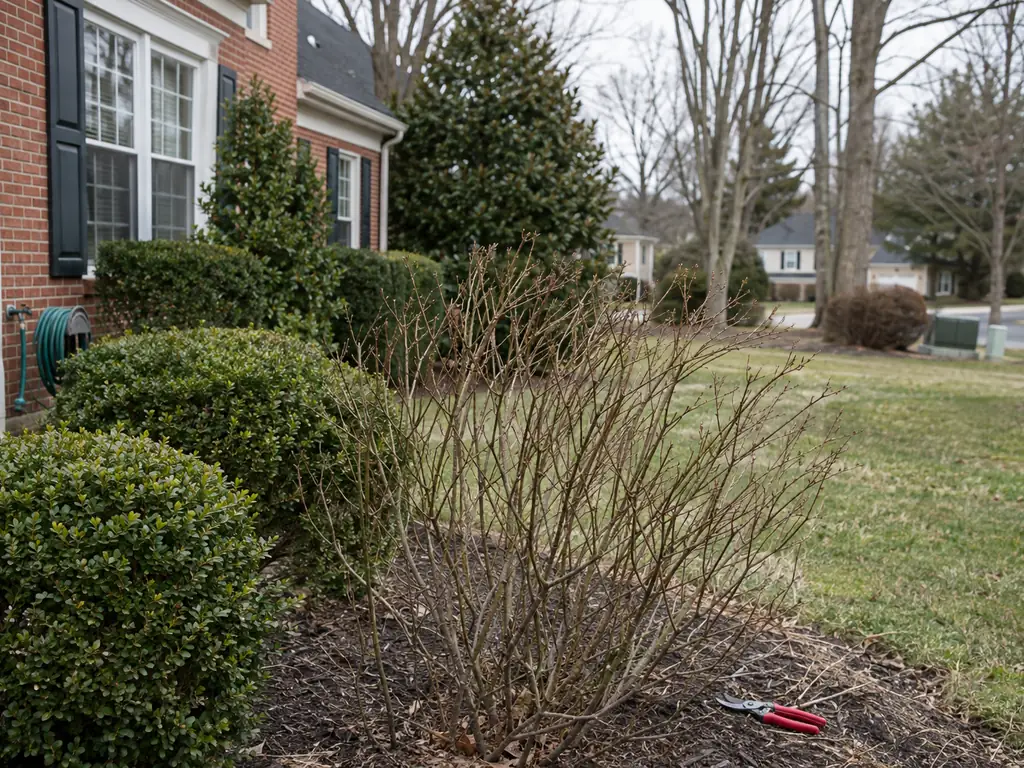
Once the leaves are down, every shrub in your yard is easy to see, and so are the overgrown ones. It is tempting to grab the loppers on the first mild Saturday in December. But knowing when to prune shrubs matters more than how much you cut. Prune the right plant at the wrong time and you can lose a whole season of flowers.
The good news is that winter is the right time for a lot of pruning in Northern Virginia. Many summer flowering shrubs, crape myrtles, boxwoods and storm damaged branches are best handled while plants are dormant. Others, like azaleas and the classic blue or pink hydrangeas, should not be touched until after they bloom.
This guide explains what to prune this winter, what to leave alone, and how to make cuts that keep plants healthy. It is based on Virginia Cooperative Extension and University of Maryland Extension research, plus more than 40 years of landscape maintenance in Northern Virginia by our crews in Fairfax, Falls Church, Annandale, Arlington and Fairfax Station.
Quick Answer: When to Prune Common Northern Virginia Shrubs
| Plant | Best time to prune | Prune this winter? |
|---|---|---|
| Summer blooming shrubs (rose of Sharon, abelia, beautyberry, shrub roses) | Winter or early spring, before new growth starts | Yes, late winter |
| Crape myrtles | Late winter or early spring, before new growth | Yes, late winter (never top them) |
| Smooth and panicle hydrangeas | Late winter or early spring | Yes, late winter |
| Boxwoods | Thin them in winter, December through February | Yes |
| Hollies and other evergreens | Light trims for holiday greens in winter; heavy pruning in early spring | Light trims only |
| Spring bloomers (azaleas, rhododendrons, forsythia, lilacs) | Right after they finish flowering | No |
| Bigleaf and oakleaf hydrangeas | Just after the flowers fade in summer | No |
| Berry shrubs (viburnum, pyracantha, cotoneaster) | After the fruit drops | Usually wait |
| Broken or storm damaged branches | Right away, any time of year | Yes |
Is It OK to Prune Shrubs in Winter?
Yes, for many plants it is the best time. Virginia Cooperative Extension’s guide to pruning deciduous trees explains that late winter or early spring, before bud break, is a good time to prune many species because the wounds heal quicker once growth starts.
Dormant pruning has practical advantages too. With the leaves gone, you can see the branch structure clearly, spot crossing or rubbing stems, and shape the plant without guessing.
There are two timing traps to avoid:
- Do not prune in fall. University of Maryland Extension’s guide to pruning shrubs and hedges warns against pruning from about August to late October. New growth triggered then does not have time to harden off before winter and can be killed by cold.
- Do not cut off next spring’s flowers. Shrubs that bloom before the end of June set their flower buds the summer before. Any pruning in fall, winter or early spring removes those buds.
When you are unsure, Maryland Extension’s advice is simple: prune in early spring. You may lose flowers for one year, but the shrub itself will not be harmed.
For most landscapes in Fairfax and Falls Church, the sweet spot for dormant pruning is late winter, after the worst cold has passed and before buds begin to swell.
Which Shrubs Should You Prune in Late Winter?
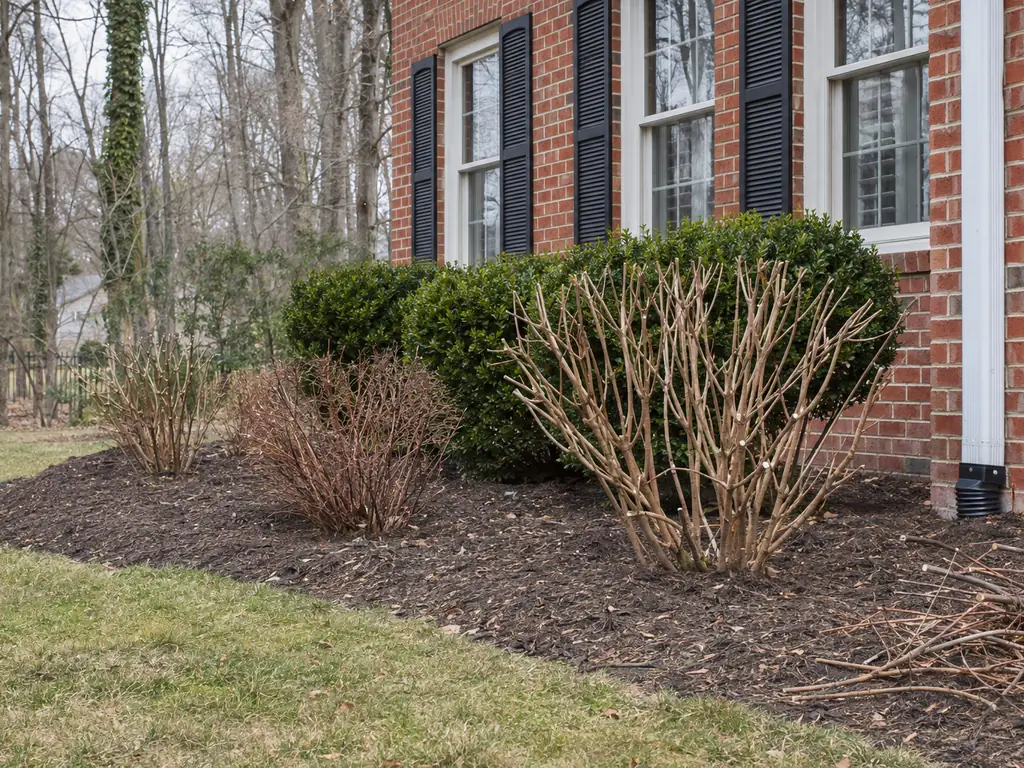
The rule of thumb is to prune plants that bloom on new wood, meaning stems that grow in the coming spring. Cutting them back in late winter does not remove any flowers, because the flower buds have not formed yet.
Good candidates for late winter pruning in Northern Virginia include:
- Summer and fall blooming shrubs such as rose of Sharon, abelia, beautyberry and shrub roses. Maryland Extension recommends pruning these in winter or spring before new growth begins.
- Crape myrtles. They flower on current season growth, so late winter is the right time (more on this below).
- Smooth hydrangeas (such as ‘Annabelle’) and panicle hydrangeas, which also bloom on new wood.
- Overgrown deciduous shrubs that need renewal. Maryland Extension recommends renewal pruning in late winter or early spring, before new growth appears. You remove the oldest, weakest stems near the ground and leave the younger, vigorous ones. On spring bloomers, expect to give up some flowers for a season or two in exchange for a healthier shrub.
- Deciduous hedges. Cutting out one third to one fourth of the oldest branches each year, before new growth starts, keeps hedges vigorous for years.
Which Shrubs Should You Not Prune in Winter?
This is where most well meaning winter pruning goes wrong. Leave these plants alone until the right time:
- Spring flowering shrubs. Azaleas, rhododendrons, forsythia and lilacs already carry next year’s flower buds. Prune them right after they finish blooming in spring.
- Bigleaf and oakleaf hydrangeas. These bloom on old wood. The fat buds you see on the stems in winter are this summer’s flowers.
- Shrubs grown for their berries. Maryland Extension advises waiting until the fruit drops on plants like cotoneaster, pyracantha and viburnum.
- Evergreens that need a hard cutback. Save severe pruning of evergreens for early spring, when new growth can quickly cover the cuts.
One exception applies to everything: broken, split or storm damaged branches should come off as soon as you notice them, whatever the season.
When Should You Prune Crape Myrtles in Northern Virginia?
Drive through almost any Northern Virginia neighborhood in February and you will see crape myrtles cut back to bare stubs. Virginia Cooperative Extension calls this “crape murder,” and its guide to pruning crapemyrtles explains why it does real harm.
The right time to prune a crape myrtle is late winter or early spring, before new growth begins. Do not prune in late summer or early fall, because any new shoots may freeze before they go dormant.
What matters even more is how you prune:
- Do not top them. Topping means cutting stems back to an arbitrary height. Research cited by Virginia Tech found topping significantly increases stem decay. It also produces clusters of weak, fast shoots whose heavy blooms often break off in wind, and plants that have been topped tend to sprout more suckers at the base.
- Remove the problem branches only. Take out dead, diseased, broken, crossing and rubbing branches. A well trained crape myrtle does not need pruning every year.
- Use the right cut. To shorten a branch, cut just above an outward facing bud or side branch. To remove a whole branch, cut just outside the branch collar.
- Skip the pruning paint. Extension advises against putting any material on the cut ends.
- Rub off suckers early, while they are young and soft.
If your crape myrtle has already been topped, it can be partly fixed. Virginia Tech recommends keeping two or three of the strongest shoots at each knuckle and removing the rest, then heading the keepers back to outward facing buds to start a better branch structure.
If a crape myrtle needs cutting back every year to fit its spot, the real problem is that the variety is too big for the space. In that case, replacing it with a smaller cultivar is usually the better long term fix.
Can You Cut Back Hydrangeas in Winter?
Some, yes, and some, no. It depends on which type you have. University of Maryland Extension’s guide to pruning hydrangeas groups them by when they form their flower buds:
| Hydrangea type | How to recognize it | When to prune |
|---|---|---|
| Bigleaf (mophead or lacecap) | Large round or flat blooms, the only common type that can turn blue or purple | Just after flowers fade in summer |
| Oakleaf | Leaves shaped like oak leaves | Just after flowers fade in summer |
| Smooth (such as ‘Annabelle’) | Rounded blooms, white on most varieties | Late winter or early spring |
| Panicle (including “PeeGee”) | Cone shaped flower clusters, the last to bloom | Late winter or early spring |
| Reblooming varieties | Bloom on both old and new wood | Early spring or after the first flush of flowers |
The most common reason a bigleaf hydrangea does not bloom is pruning at the wrong time. If yours is blue, pink or purple, leave the stems alone this winter. Maryland Extension notes that faded flower heads can even add winter interest, and removing them is not needed for plant health.
How Should You Prune Boxwoods, Hollies and Other Evergreens?
Evergreens are a staple of Northern Virginia foundation plantings, and they need a lighter touch than deciduous shrubs.
- Thin boxwoods instead of shearing them. University of Maryland Extension’s boxwood guide says the best time to thin boxwood is winter, December through February. Thinning means removing whole stems at their point of attachment so light and air reach the center. Regular shearing creates dense outer foliage that encourages fungal diseases.
- Trim hollies for holiday greens. Maryland Extension notes that winter is fine for cutting holly and other evergreen branches for decorations. Save heavy pruning for early spring.
- Do not cut into bare wood. Most evergreens will not regrow from old wood that has no leaves or needles. Maryland Extension lists yews, junipers, hemlocks, false cypress and arborvitae as the exceptions that respond to harder pruning.
- Use hand pruners on large leaves. Shears are fine for small leaved plants like boxwood, but they tear big leaves on plants like rhododendron, which then turn brown.
- Shape hedges narrower at the top. A hedge that is wider at the base than the top lets light reach the lower branches. A slightly rounded or pointed top also sheds snow, which helps prevent broken branches.
How Do You Make Good Pruning Cuts?
Clean, correct cuts heal faster and keep plants looking natural. Virginia Tech’s pruning guides recommend these basics:
- Know your two cuts. A thinning cut removes a branch back to where it starts, which opens up the plant without a flush of regrowth. A heading cut shortens a stem and makes the buds just below it sprout, so use it selectively.
- Cut about 1/4 inch above a bud, sloping down and away from it.
- Cut outside the branch collar, the swollen area where a branch joins the trunk. Leaving the collar helps the wound close.
- Use the three cut method on limbs over 1 inch thick so the weight of the branch does not tear the bark.
- Skip wound dressing. It does not prevent decay and may slow healing.
- Disinfect tools when removing diseased wood. Virginia Tech suggests products such as Lysol, Listerine or rubbing alcohol between cuts, and warns that household bleach and Pine-Sol corrode tools.
- Keep blades sharp. Sharp pruners make clean cuts that close quickly.
Remember that pruning does not stop a plant from growing. Maryland Extension points out that it actually stimulates new growth, so a shrub that is simply too big for its space will keep needing cuts.
What Should You Do About Winter Storm Damage?
Snow and ice are hard on shrubs. Virginia Tech advises pruning branches damaged by storms right away, rather than waiting for the normal pruning season.
- Brush off heavy snow gently, sweeping upward with a broom. Leave branches coated in ice alone until it melts, since frozen branches snap easily.
- Support upright boxwoods before a big snow. Maryland Extension suggests tying twine at the base and spiraling it up the plant to keep branches from splaying apart.
- Cut broken branches back cleanly to a healthy side branch or the branch collar, so the plant is not left with ragged stubs.
- Leave large tree limbs to the professionals. For big limbs, high branches or anything near power lines, call a certified arborist or your utility company.
Our November and December lawn care guide has more on protecting your yard from frost, ice and rock salt this winter.
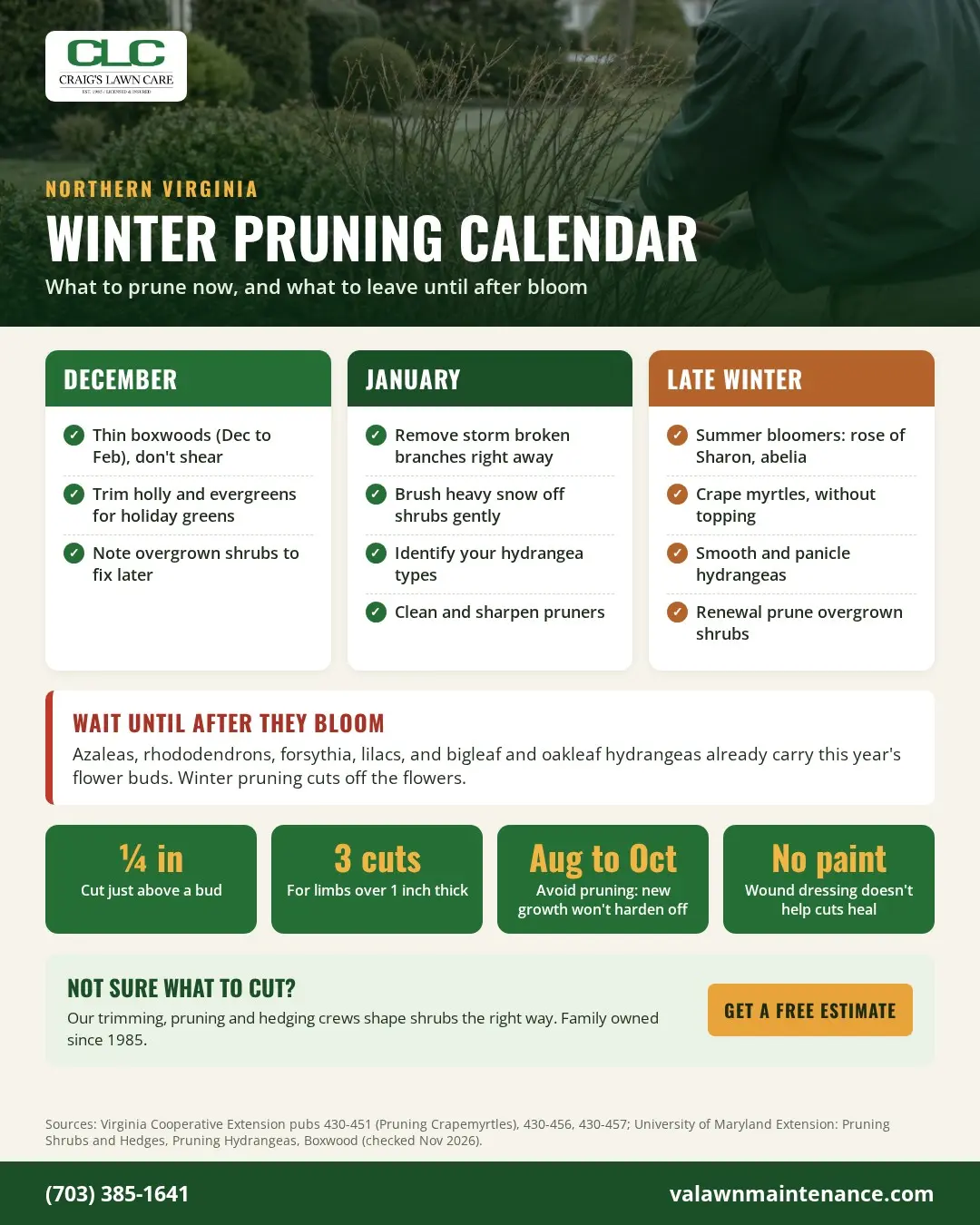
Your Winter Pruning Checklist for Northern Virginia
December
- Thin boxwoods, removing whole stems from inside the plant.
- Cut holly and evergreen branches for holiday decorating.
- Walk the yard and note shrubs that are crowding walkways, windows or each other.
January
- Check shrubs after every snow or ice storm and remove broken branches.
- Identify your hydrangeas so you know which ones to leave alone.
- Sharpen and clean your pruners, loppers and saw.
Late winter, before buds swell
- Prune summer blooming shrubs, crape myrtles, and smooth and panicle hydrangeas.
- Do renewal pruning on overgrown deciduous shrubs and hedges.
- Leave azaleas, rhododendrons, forsythia, lilacs and bigleaf hydrangeas until after they bloom.
How Do You Book Shrub Pruning and Landscape Maintenance in Northern Virginia?
Craig’s Lawn Care is a family owned company that has served Northern Virginia since 1985, and was voted Best Lawn Care Service in Fairfax County in the FFXnow Readers’ Choice Awards. Our trimming, pruning and hedging service keeps shrubs neat, healthy and properly shaped. Plants are trimmed to your specifications, and when none are given, our team chooses the right height and form for each plant type and its condition.
If you would rather not guess which shrubs to cut and when, we can build pruning into a landscape maintenance plan tailored to your property, plant types and seasonal needs.
- Call us at (703) 385-1641 to talk with our team.
- Request a free estimate on our landscape maintenance page.
- Plan the year ahead with our seasonal lawn care checklist.
Frequently Asked Questions
What month is best to prune shrubs in Northern Virginia?
It depends on the shrub. Summer blooming shrubs, crape myrtles and smooth or panicle hydrangeas are best pruned in late winter, before new growth starts. Spring bloomers such as azaleas and forsythia should be pruned right after they flower. Boxwoods can be thinned from December through February.
What shrubs should not be pruned in winter?
Avoid winter pruning on spring flowering shrubs such as azaleas, rhododendrons, forsythia and lilacs, and on bigleaf and oakleaf hydrangeas. They already carry the flower buds for the coming season, so winter pruning removes those blooms.
Is it too late to prune shrubs in December?
No, as long as you choose the right plants. December is a good time to thin boxwoods and trim evergreens for holiday greens. Save most other pruning for late winter, and avoid heavy cuts on evergreens until early spring.
When should you cut back crape myrtles?
In late winter or early spring, before new growth begins. Only remove dead, damaged, crossing and rubbing branches, and never top the trunks. Virginia Cooperative Extension warns that topping increases decay and leads to weak, top heavy shoots.
Can I cut my hydrangeas to the ground in winter?
Only smooth hydrangeas, and panicle hydrangeas if you want them shorter, should be cut back in late winter. University of Maryland Extension suggests about 12 inches off the ground for smooth hydrangeas. Bigleaf and oakleaf hydrangeas bloom on old wood, so cutting them back in winter removes this year’s flowers.
Why should you not prune shrubs in the fall?
Pruning in late summer and fall encourages new growth that does not have time to harden off before winter. That tender growth can be damaged or killed by cold, which is why extension specialists recommend waiting until late winter or the right season for each plant.