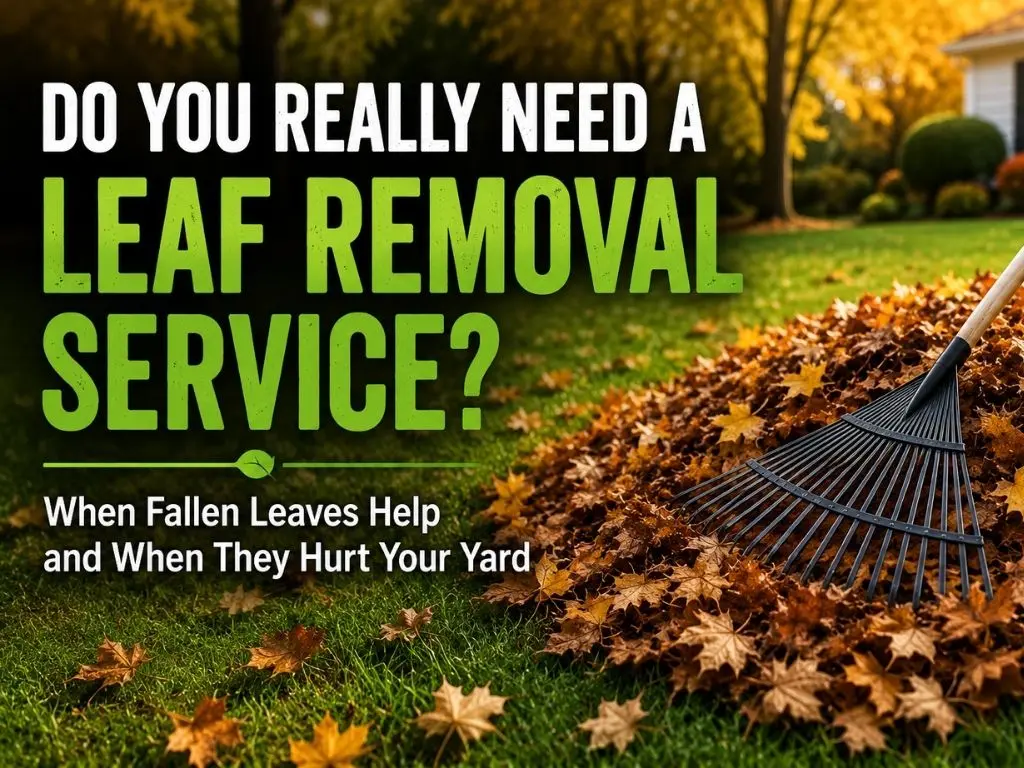

The leaves are coming down fast on every street from West Broad to Annandale Road, and the City’s leaf trucks are already rolling. For most Falls Church lawns, the next eight weeks are the last real chance to set up a thick, green lawn for spring. Good lawn care in Falls Church, VA in November and December is less about big projects and more about doing a few things at the right time.
Most lawns here are cool season grasses like tall fescue. They keep growing well into November, store energy through early winter, and show the results next April. What you do now with leaves, your last mows, your final feeding and your winter prep decides whether you start spring with a healthy lawn or a patchy one.
This guide covers exactly what to do in November and December, based on Virginia Cooperative Extension research and what our crews have seen on Northern Virginia lawns every fall and winter since 1985.
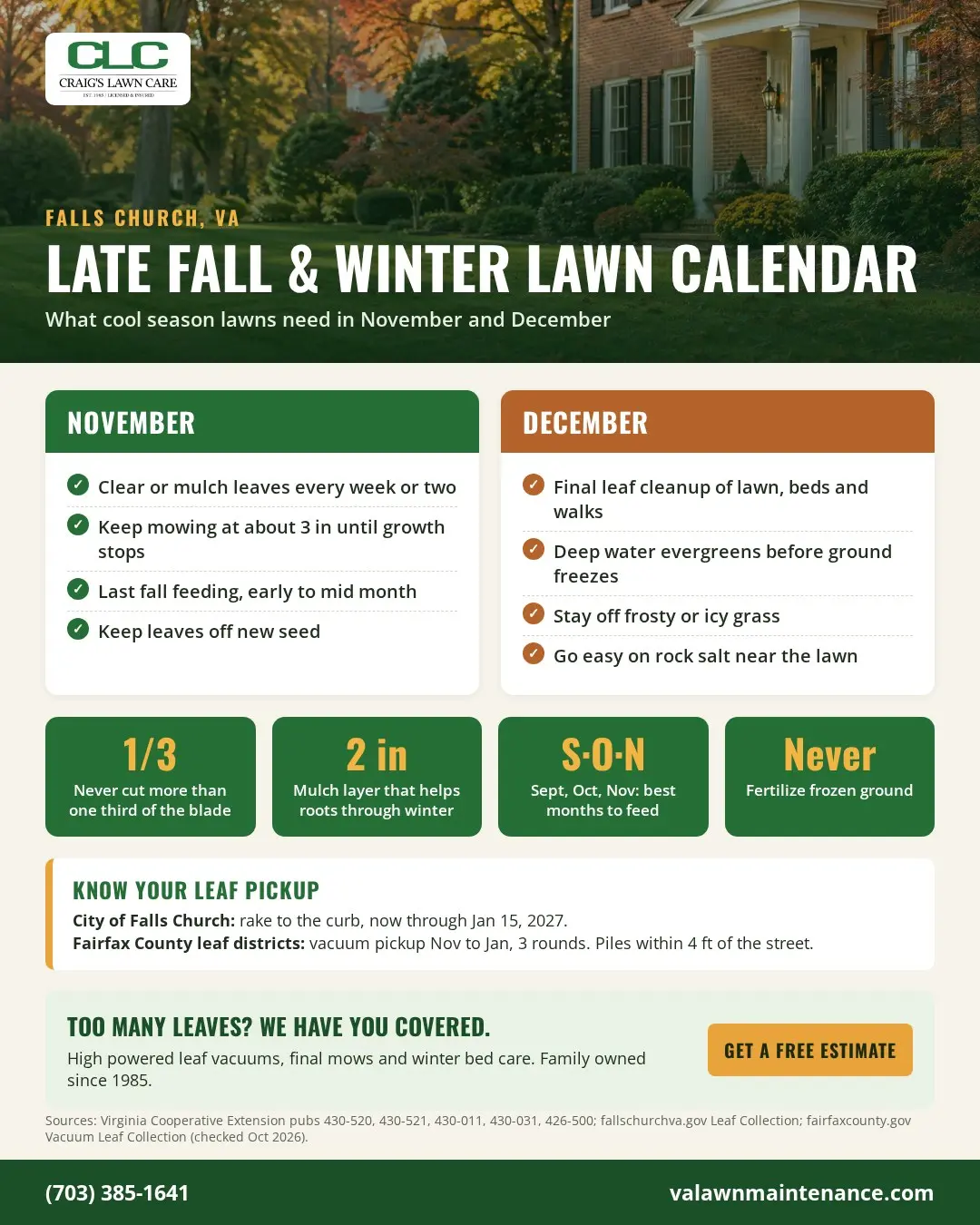
Quick Answer: Your November and December Lawn Checklist
| Task | When | Why it matters |
|---|---|---|
| Clear or mulch leaves every week or two | All of November and December | Thick, wet leaf layers block sunlight and raise disease risk |
| Keep mowing at about 3 inches | Until the grass stops growing, often late November | Never cut more than one third of the blade at a time |
| Last fall feeding for tall fescue | Early to mid November, before the ground freezes | November is the last month of the “SON” feeding window |
| Rake leaves to the curb (City of Falls Church) | Now through January 15, 2027 | City crews vacuum curbside leaves on a rolling schedule |
| Vacuum leaf pickup (Fairfax County leaf districts) | November to January | Three collection rounds in designated areas only |
| Deep water evergreens and refresh mulch | Before the ground freezes | Helps prevent winter burn on hollies, boxwoods and conifers |
| Stay off frosty grass and go easy on rock salt | December onward | Prevents footprint damage and salt burn along walks and drives |
What Does Your Falls Church Lawn Need in November?
November is the busiest lawn month of the year in Falls Church. Leaf drop peaks, the grass is still growing, and the window for feeding closes. Focus on these four jobs:
- Stay ahead of the leaves. Do not let them pile up for weeks. Two or three passes spread across the month are far easier on the lawn than one big cleanup in December.
- Keep mowing. Cooler days slow the grass down, but it has not stopped. Mow when it needs it, not on a fixed calendar.
- Make your last feeding count. November is the final month of the fall feeding window for cool season grass (details below).
- Look after any new seed. If you aerated and overseeded in September, keep leaves off the young grass and limit foot traffic. Seedlings need every hour of sunlight they can get going into winter.
Hold off on heavy pruning of trees and shrubs. Structural pruning is better left for late winter, when plants are dormant and branches are easy to see.
How Do You Handle Peak Leaf Season Without Smothering the Grass?
This is the big one for Falls Church. Our tree canopy is one of the best things about living here, and it drops a lot of leaves on a lot of small lots, mostly in November.
Virginia Cooperative Extension’s guide to lawn leaf management explains the risk simply: a thick layer of leaves blocks sunlight, slows grass growth, and traps moisture in the turf canopy, which raises the risk of disease. Left in place through winter, a heavy mat can leave thin or dead patches by spring.
You have three good options:
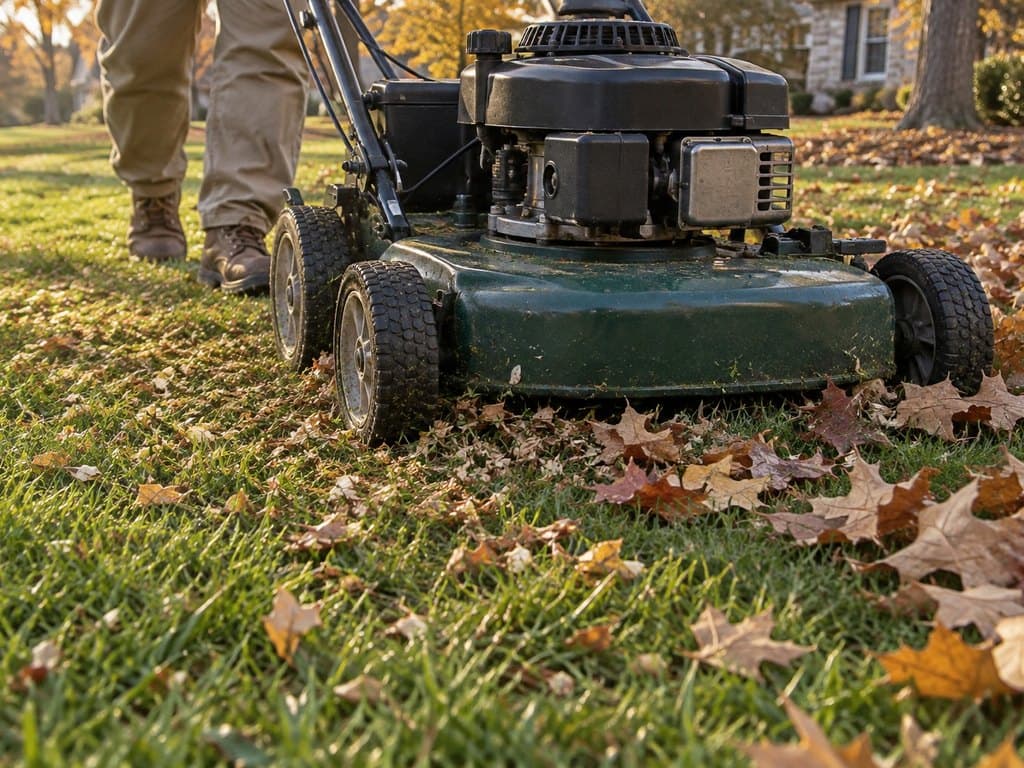
- Mulch them in. A rotary mower can chop light to moderate leaf cover into small pieces that break down in the lawn. University research cited by Virginia Tech found this has no harmful effect on turf quality, thatch or soil when done properly. Michigan State research cited by Virginia Tech found mowers can handle up to about 6 inches of leaves at a time, though several passes may be needed.
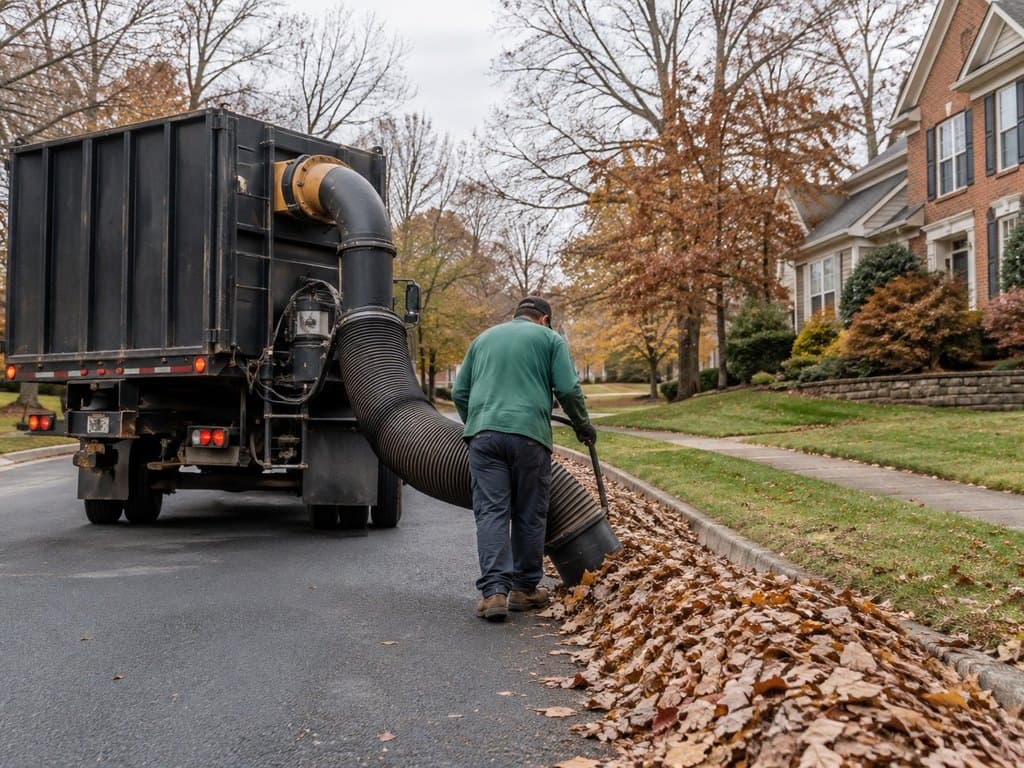
- Rake or blow them to the curb. If you live in the City of Falls Church or a Fairfax County leaf district, the municipal vacuum trucks will collect them on their schedule.
- Have them removed. For heavy leaf fall, steep yards or properties without municipal pickup, a professional cleanup clears everything in one visit.
Our August article on when fallen leaves help and when they hurt your yard goes deeper on choosing the right approach.
City of Falls Church vs Fairfax County: know your leaf schedule
Here is a detail many neighbors miss. A Falls Church mailing address does not always mean the City of Falls Church. Many homes with Falls Church addresses are in Fairfax County, and the two run different leaf programs this winter.
- City of Falls Church: According to the City’s leaf collection page, the season runs from October 26, 2026 through January 15, 2027, weekdays from 7 a.m. to 3:30 p.m., and may stretch into evenings and Saturdays as the season goes on. Rake leaves to the curb, but keep them out of gutters and storm drains and away from parked cars. If crews have already passed your street, bag and tag the leaves or use your Yellow Organics Cart instead.
- Fairfax County: The County’s vacuum leaf collection only serves designated leaf districts, from November through January, with three rounds of pickup. Leaves go to the curb no later than the day before your scheduled date, in piles no more than 4 feet from the edge of the street. Not every County household is in a leaf district, so check the County’s service area map first.
If you are not covered by either program, or the trucks have already passed your street, our leaf removal service includes curbside leaf vacuuming with our own high powered equipment.
What Height Should Your Last Mow of the Year Be?
Keep mowing at your normal height until the grass stops growing, which in Falls Church often runs into late November. For most tall fescue lawns, that means staying around 3 inches right to the end.
The most important rule comes straight from Virginia Tech’s turfgrass specialists: never remove more than one third of the leaf blade in a single mowing. If your grass is 4.5 inches tall, the most you should take off is 1.5 inches.
- Do not scalp the lawn for winter. Cutting very short exposes the crown of the plant to cold and opens the door to weeds in spring.
- Do not leave it shaggy either. Long grass mats down under leaves and snow, which encourages snow mold and other disease.
- Mow when it is dry. Wet grass and wet leaves clump, clog the deck and leave a mess.
- Use a sharp blade. A clean cut heals faster, and it chops leaves more finely when you mulch.
Our regular lawn mowing service runs through the end of the growing season, so the last cuts are done at the right height without you having to think about it.
Is It Too Late to Fertilize in November?
Not yet. For tall fescue and other cool season grasses, November is still part of the best feeding window of the year. By December, it is too late.
Virginia Cooperative Extension’s Fall Lawn Care guide uses an easy acronym: SON, for September, October and November, the months when nitrogen does the most good for cool season grass. Fall feeding improves turf density, root growth and food storage, and the payoff shows up as a thicker, greener lawn next spring. Extension’s Lawn Fertilization in Virginia puts the best window for cool season grasses at mid August through early November.
Three rules keep a November feeding safe and effective:
- Never fertilize frozen ground. Virginia Tech is clear on this. Nutrients on frozen soil cannot reach the roots and can wash into storm drains. Once the ground starts freezing in December, put the spreader away until spring.
- Feed shaded lawns after the leaves drop. In shady yards, Extension notes that October and November applications are generally most effective, once sunlight can reach the grass.
- Keep it off hard surfaces. Sweep any granules off driveways, walks and streets so they do not end up in local streams.
If you skipped a soil test this year, winter is a good time to plan one. Many Virginia soils are acidic, and Extension notes that fall and winter are ideal times to apply lime because it takes weeks to months to work. Fertilizing is part of our landscape maintenance service, so feeding is timed for your lawn and handled correctly.
What Should You Do in December to Get Your Yard Ready for Winter?
Once the mower is put away, December is about protecting what you have built. A few hours now saves a lot of repair work in March.
- Do a final leaf cleanup. Clear the last leaves from the lawn, beds, walkways and patios. Wet leaves on pavers and steps get slippery fast, and leaves left on the lawn all winter can smother it.
- Deep water evergreens before the ground freezes. Virginia Tech’s guide to managing winter injury to trees and shrubs explains that evergreens keep losing moisture all winter. If autumn has been dry, give them a deep soaking that reaches the whole root system before the ground freezes, and water again on warm winter days.
- Refresh mulch where it is thin. The same guide notes that a 2 inch layer of mulch reduces water loss and keeps soil moisture even around roots. Keep mulch pulled back from trunks and stems.
- Clean gutters and yard drains. Clogged gutters overflow onto beds and foundations, and blocked drains cause soggy spots that damage turf.
- Drain and store hoses. Shut off outdoor spigots and drain hoses before the first hard freeze.
- Brush snow off shrubs gently. Sweep upward with a broom to lift heavy snow off branches. If branches are coated in ice, leave them alone until it melts so they do not snap.
How Do You Protect Your Lawn From Frost, Ice and Rock Salt?
Two winter habits cause more lawn damage in Falls Church than the cold itself: walking on frozen grass and over salting walkways.
Stay off frosty or icy grass. Virginia Tech turf specialists explain in My Turf’s on Ice that walking on frost or ice covered grass breaks the frozen leaf blades and severs the plant’s internal “pipelines.” Footprints turn brown within a few days, and on cool season lawns the marks can last well into April or May. The damage is cosmetic, but it is easy to avoid: wait until the frost melts before you cut across the lawn, and keep cars and wheelbarrows off it.
Go easy on rock salt. Virginia Cooperative Extension’s guide to plants that tolerate de-icing salts notes that sodium chloride is the most common de-icer and that damage happens when salt splashes onto plants or runs off pavement into the soil. Its prevention tips are simple:
- Use de-icer less often (shoveling first helps you need less of it).
- Mix granular de-icer 50/50 with sand to cut the total amount of salt.
- Choose calcium, potassium or magnesium based products instead of sodium based rock salt.
- Put up burlap barriers to shield sensitive shrubs next to the street.
If salt does get onto a lawn edge or bed, Extension recommends flushing it through the soil with about 2 inches of water over two to three hours once the ground thaws.
What Can You Plan Now for a Better Lawn Next Spring?
Winter is the best time to plan, because the problems are easy to see once the leaves are gone.
- Walk the yard and take notes. Mark bare spots, drainage problems, worn paths and areas where water pools after rain.
- Know your crabgrass timing. Virginia Tech research shows pre emergent crabgrass control should be in place by the time forsythia starts to drop its blooms in spring. Put a reminder in your calendar now.
- Plan aeration and overseeding for next fall. For tall fescue, late summer to early fall is the best time to seed. If your lawn has thin areas, book it early.
- Plan bigger projects. Patios, walkways, retaining walls and new plantings are easier to design over winter, so they can be built as soon as the weather allows.
How Do You Book Late Fall and Winter Lawn Care in Falls Church?
Craig’s Lawn Care is a family owned company that has served Northern Virginia since 1985, and was voted Best Lawn Care Service in Fairfax County in the FFXnow Readers’ Choice Awards. Our uniformed crews handle leaf removal and vacuuming, final mows, bed cleanups and fertilizing for homes across Falls Church, whether you are inside the City or on the Fairfax County side of town.
Here is what one client said in a recent review: “I am very pleased with my weekly lawn cutting service from Craig’s. And the personal, careful service I received during Craig’s aeration/seeding this past week was exceptional.”
Leaf removal slots fill quickly in November and December. To get on the schedule:
- Call us at (703) 385-1641 to talk with our team.
- Request a free estimate on our Falls Church lawn care page.
- Browse the year ahead with our seasonal lawn care checklist for every month.
Frequently Asked Questions
Should I still mow my lawn in December?
Usually not. In Falls Church, tall fescue often stops growing by late November. Keep mowing at about 3 inches until it stops, never cutting more than one third of the blade at once, and do not scalp it for winter. If a warm spell brings new growth in December, one more light mow is fine.
Is it too late to fertilize my lawn in December?
Yes, for most Falls Church lawns. Virginia Tech’s “SON” rule puts the best feeding months for cool season grass at September, October and November. Never fertilize frozen ground. Wait until spring if you missed the fall window.
When does leaf collection end in Falls Church?
In the City of Falls Church, the leaf season runs through January 15, 2027. Fairfax County runs vacuum leaf collection from November through January, but only in designated leaf districts. Check which program covers your address.
Is it bad to walk on frosty grass?
Yes. Walking on frost or ice covered grass breaks the frozen blades, and the brown footprints can last into spring on cool season lawns. The damage is cosmetic, but it is best to wait until the frost melts.
Is rock salt bad for my lawn and plants?
It can be. Sodium based rock salt can burn grass and shrubs along driveways and walks. Shovel first, use less de-icer, mix it with sand, or choose calcium, potassium or magnesium based products.
Is it too late to seed my lawn in November?
For most Falls Church lawns, yes. The best seeding window for tall fescue is late summer to early fall, and seed sown this late often struggles through winter. If you have bare spots, plan aeration and overseeding for next September.